Quantum computing has a trust problem. When a quantum machine produces an answer no ordinary computer can feasibly produce, there is no obvious way to tell whether the answer is right.
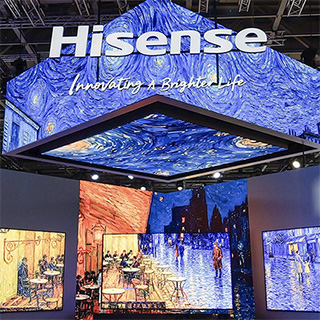
Hisense is raising the stakes in the premium TV segment with the announcement of the Hisense 116UXS – its flagship RGB Mini LED TV that will set the course of technology development for next year’s models by the brand. The colossal 116‑inch model represents the next stage in RGB MiniLED innovation, built on Chromagic 2.0 Technology. Its four‑color backlight introduces a dedicated cyan emitter…
South Korea’s safety-tech sector may be increasingly filled with AI cameras, robots, drones, and predictive systems, but BEXCO general manager Tom Choi argues that the force pushing many of those technologies toward actual deployment begins somewhere less glamorous: government policy.
Samsung Electronics Chairman Jay Y. Lee and SK Group Chairman Tae-won Chey are traveling to New York at the end of September 2026 to meet Nvidia CEO Jensen Huang again as Washington presses South Korean companies to expand US investment. The planned trip is drawing market attention because Samsung Electronics and SK Hynix are already pursuing large-scale spending in the US and could discuss further business ties on the sidelines of the event.
National Yang Ming Chiao Tung University (NYCU) has recruited 2013 Nobel Prize in Chemistry laureate Arieh Warshel to work in Taiwan, and the National Development Council (NDC) has issued him an Employment Gold Card enabling him to work and reside in Taiwan. It is the first time a Nobel laureate has received the card since the program began.
Dutch equipment maker ITEC used Semicon Taiwan to promote a die-bonding architecture that it says triples throughput over earlier versions of the design by removing the largest source of idle motion in chip assembly: the return trip.
As Semicon Taiwan kicked off at the Taipei Nangang Exhibition Center, the Ministry of Economic Affairs (MOEA) announced that, based on forecasts compiled from multiple research institutions, Taiwan’s semiconductor industry output could top NT$8 trillion (approx. US$252.6 billion) in 2026. Advanced equipment and materials, historically local industry weak points, are also making remarkable gains, with domestic equipment output projected to reach NT$270 billion (US$8.5 billion).
System integration remains a key hurdle as the AI chip industry pushes for higher power efficiency and faster transmission speeds, drawing intense attention to when short-reach optical communications between racks and chips will enter practical use. Industry players say the maturity of system integration is still the main consideration for commercialization.
TSMC is steering the future of artificial intelligence toward high-density three-dimensional advanced packaging designed to mimic the architectural connectivity of the human brain, as traditional two-dimensional silicon scaling approaches its physical limits, a top TSMC executive said at SEMICON Taiwan 2026.